

Affected product(s):
Linux Kernel — KVM/x86 Subsystem (Kernel-based Virtual Machine)
| Product | Affected versions | Fixed version |
| Linux Kernel (mainline) | 5.9 through 7.1.5 | 7.1.6 |
| Linux Kernel (stable 6.18.x) | 6.18 through 6.18.41 | 6.18.42 |
| Linux Kernel (stable 6.12.x) | 6.12 through 6.12.100 | 6.12.101 |
| Linux Kernel (stable 6.6.x LTS) | 6.6 through 6.6.147 | 6.6.148 |
| Red Hat / RHEL | Versions with affected KVM | Update pending |
| Debian (bullseye, bookworm, trixie) | All current branches | Patch in distribution |
| CloudLinux 7h, 8, 9, 10 | Affected | Patch published |
Description
A use-after-free vulnerability has been disclosed in the KVM/x86 subsystem of the Linux kernel. It has been identified as CVE-2026-64561 with a CVSSv3.1 score of 7.0 — Important; the researcher named it Zapscape,
The flaw allows an attacker with root privileges inside a guest virtual machine (L1), on systems with nested virtualization enabled, to escape the VM isolation and execute arbitrary code with root privileges on the physical host.
Unlike previous similar vulnerabilities, Zapscape is exploitable on both Intel (Ice Lake-SP and later) and AMD processors, significantly expanding the attack surface.
The flaw resides in an incorrect validation order in the handling of guest page faults within KVM/x86’s shadow MMU. When KVM attempts to reuse a shadow page, it does not properly check whether the page root had already been marked as invalid by the memory reclamation process (make_mmu_pages_available()).
If the reclaim invalidates the active root, KVM continues attempting to map memory within that invalid root. As a consequence, the child shadow pages created during the process inherit the invalid state from the parent, violating KVM’s internal invariant which states that invalid pages must never be in the active MMU pages list. This generates a memory corruption condition exploitable for VM escape.
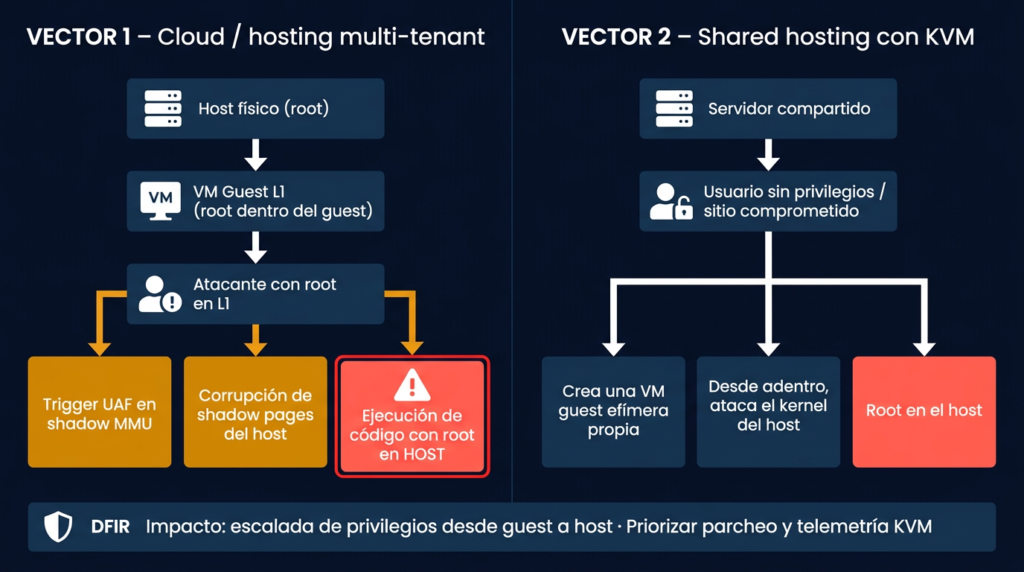
Figure 1 – Privilege Escalation in Virtualization: KVM Guest-to-Host Attack Vectors
Additionally, the PoC (Proof of Concept) code has been published on GitHub just days after the announcement, making the risk of active exploitation immediately elevated.
The patch moves the stale root check to run after make_mmu_pages_available(). If the reclaim invalidates the current root, KVM now restarts fault handling with RET_PF_RETRY instead of continuing to map under an invalid root.
Solution
Update the kernel to the fixed versions:
| Branch | Fixed version |
| Mainline | 7.1.6 or 7.2-rc5 |
| Stable 6.18.x | 6.18.42 |
| Stable 6.12.x (LTS) | 6.12.101 |
| Stable 6.6.x (LTS) | 6.6.148 |
Kernel update in various distributions:
# Debian / Ubuntu
apt update && apt upgrade linux-image-$(uname -r)
# RHEL / CentOS / AlmaLinux / Rocky
dnf update kernel
# CloudLinux
yum update kernel
# Arch Linux
pacman -Syu linux
# Verify version after update
uname -r
Mitigation
While planning the application of the kernel patch, you can follow these recommendations:
- Disable nested virtualization on all hosts where it is not strictly necessary. This is the most effective mitigation as it eliminates the main prerequisite of the attack:
# QEMU/KVM — disable nested virt per VM
-cpu ${CPU},vmx=off,svm=off
# Or at the kernel module level
echo “options kvm_intel nested=0” >> /etc/modprobe.d/kvm.conf
echo “options kvm_amd nested=0” >> /etc/modprobe.d/kvm.conf
modprobe -r kvm_intel && modprobe kvm_intel
- Apply live patching with tools such as KSplice or kpatch as a first-aid measure while scheduling a reboot to update the kernel.
- Audit which VMs have access to nested virtualization in the environment and restrict it exclusively to trusted guests.
- In multi-tenant cloud environments: review the configuration of cpu_flags exposed to guests and remove vmx/svm from untrusted third-party guests.
- Monitor unusual access attempts to the KVM subsystem from within VMs.
Additional information:
- The Hacker News — Zapscape CVE-2026-64561: https://thehackernews.com/2026/08/new-zapscape-kvm-flaw-could-let.html
- NVD — CVE-2026-64561: https://nvd.nist.gov/vuln/detail/CVE-2026-64561
- Red Hat — CVE-2026-64561: https://access.redhat.com/security/cve/cve-2026-64561
- CloudLinux — Analysis and mitigation: https://blog.cloudlinux.com/zapscape-cve-2026-64561
- Debian Security Tracker: https://security-tracker.debian.org/tracker/CVE-2026-64561
- Hispasec — Technical analysis in Spanish: https://unaaldia.hispasec.com
- Upstream fix commit: 2abd5287f083 — linux/kernel/git/torvalds/linux
https://git.kernel.org/pub/scm/linux/kernel/git/torvalds/linux.git/commit/?id=2abd5287f083