The same old story
In 2026, the incident that affected a cybersecurity services provider a security services provider in Mexico once again delivered an uncomfortable but necessary lesson: a provider’s security can no longer be treated as an “external” problem. Public reports indicated that a third party with privileged access to connectivity, network administration, and video surveillance for multiple clients had allegedly been compromised. The company involved acknowledged the incident and stated that it had activated containment and investigation measures; however, several of the technical details released so far—such as the volume of information allegedly extracted or the number of affected devices—remain without independent verification. Even with that caveat, the case is serious enough to draw practical conclusions.
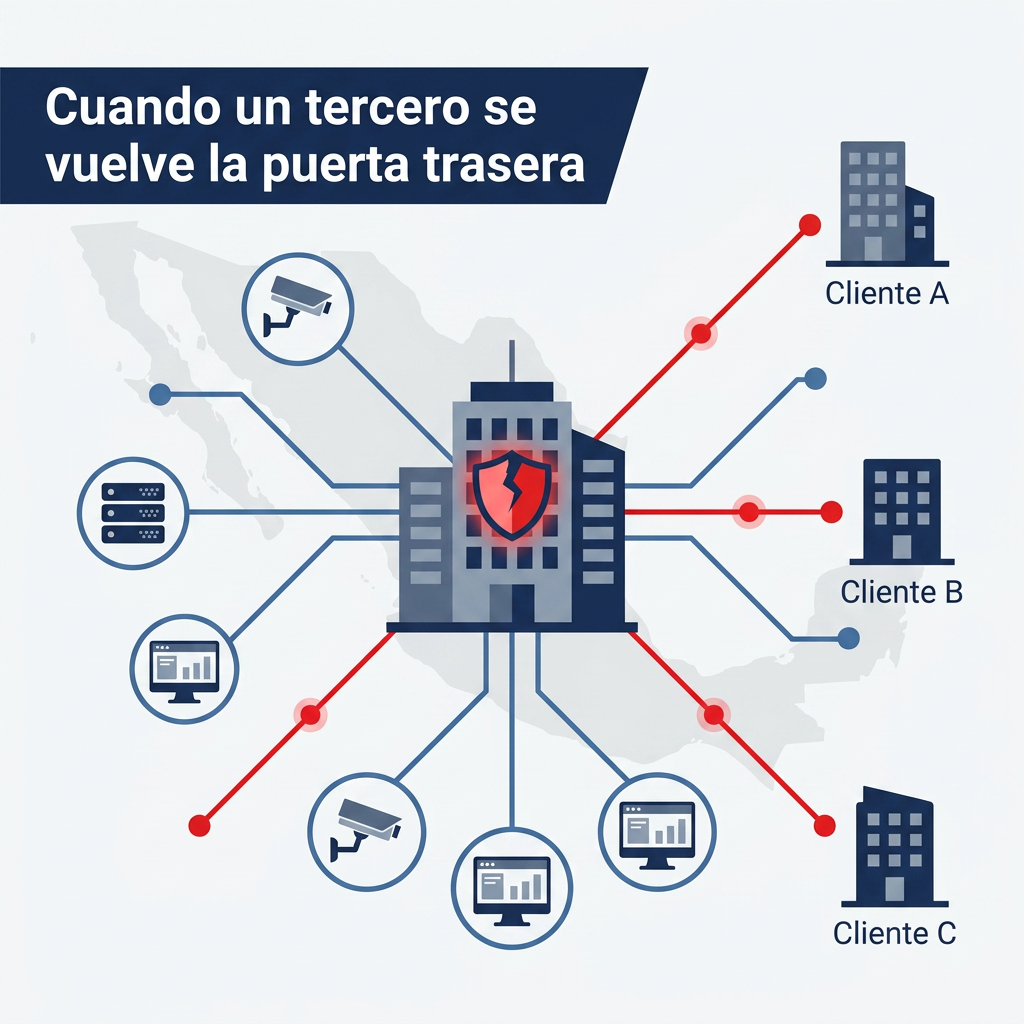
What matters is not only the incident itself, but what it represents. When a provider centralizes remote access, operational visibility, and credentials with elevated privileges across multiple environments, it stops being a peripheral actor and becomes a direct extension of its clients’ attack surface. In that scenario, a single compromised account can become a cross-cutting door into networks, cameras, administration panels, and critical assets.
Attack breakdown
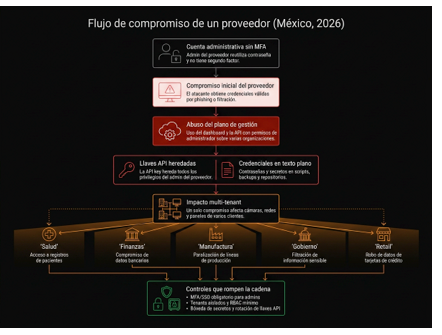
The most solid technical hypothesis, based on what has been reported and on the information available online, is a combination of compromised administrative accounts and abuse of the cloud management plane. If a privileged account lacks MFA, the attacker does not need to exploit a 0-day or deploy complex malware: obtaining a valid password through phishing, password reuse, credential stuffing, prior theft, or an indirect leak is enough. In other words, the entry point would not have been an unknown vulnerability, but the absence of basic controls on a critical account. This aligns with MITRE ATT&CK technique T1078 Valid Accounts, including its variant T1078.004 Cloud Accounts.
The vendor’s documentation is key to understanding the potential blast radius. The dashboard API inherits the same permissions as the administrator account that generates it, and if that account has access to multiple organizations, the same key can reach all of them. The vendor offers controls to mitigate this risk—such as mandatory MFA at the organizational level and restrictions preventing SAML administrators from generating API keys—precisely to stop each user from enabling or disabling these mechanisms at will. The problem is that these kinds of controls are not always implemented correctly or applied consistently.
Put another way: if there was API key abuse, the case would point to excessive privileges and the possible persistence of privileged local accounts or keys already issued. If the attacker generated new keys, that scenario would be more consistent with non-federated accounts or weak identity controls. That part remains, for now, an analytical inference and not a publicly confirmed fact.
Another frequent—and often underestimated—bad practice is storing credentials in plain text. It is not just about passwords: there are also secrets embedded in configuration files, scripts, backups, or shared repositories that may contain API keys, certificates, hashes, and other reusable material for authenticating or escalating privileges. When those secrets are exposed, the attacker does not just access a system: they gain the ability to persist, pivot, and expand the compromise.
So far, there is no public evidence of a specific exploit, a particular malware family, ransomware, destructive firmware manipulation, or an especially sophisticated intrusion chain. For now, the public narrative looks more like a case of living off the management plane than one of destructive malware: the attacker would have abused legitimate access, valid credentials, and native functions of the management environment.
What can be learned?
The main lesson is that many serious breaches do not start with “movie-style” tools, but with missing basic controls. The most consistently reported vector was the possible use of administrative accounts without multi-factor authentication and the eventual abuse of API keys on the management plane. When a provider centralizes privileged identities, remote access, and visibility over multiple clients at the same time, a single compromised account can become a cross-cutting door to observe cameras, enumerate devices, move configurations, or prepare follow-on attacks. The problem is not only a stolen password, but the combination of privileges, centralization, and lack of segmentation.
It also leaves a critical lesson about “secondary” information that is often underestimated. If credentials in plain text, audit documentation, or pentesting reports are exposed during an intrusion, the attacker does not just steal data: they steal operational knowledge. These types of documents often reveal what assets exist, where the weaknesses are, which flaws remain unaddressed, and how they were prioritized. That reduces the adversary’s uncertainty and accelerates follow-on attacks. That is why protecting secrets, keys, backups, and technical assessments is as important as protecting traditional databases. Encrypting files is not enough; it is also necessary to limit access, reduce retention times, label sensitive material, and monitor who downloads, views, or exports critical information.
Effective prevention must combine technical, operational, and vendor management controls. On the technical side, this implies mandatory MFA for administrators, SSO where feasible, separate accounts per client, least privilege, a secrets vault, and continuous review of API activity. Operationally, it implies support access under PAM/JIT schemes, with explicit approval, automatic expiration, session recording, and post-review. And on the third-party front, it demands contracts with clear notification clauses, defined response times, audit rights, and minimum required evidence after an incident. As important as prevention is knowing how to communicate: in incidents of this type, a useful response does not consist of stating that “the case is being investigated,” but of delivering actionable information about what happened, what data may be involved, what controls failed, what was corrected, and what potentially affected customers should do now.
Risks and mitigations
| Vector | What it enables | Actionable mitigation |
| Administrative account without MFA | A stolen password can unlock management and enable abuse of valid credentials | Enforce MFA/SSO at the organizational level, disable unnecessary local accounts, apply conditional access, and maintain at least two full backup administrators |
| API keys with inherited permissions | The key inherits admin privileges; if that admin oversees multiple clients, the blast radius multiplies | Inventory, rotate, and revoke keys; use dedicated service accounts per client; review analytics for APIs, admins, apps, and source IPs |
| Credentials/secrets in plain text or files | Enable escalation, persistence, and reuse across other systems | Move secrets to a vault, enable secret scanning, prohibit secrets in files, backups, and scripts, and audit repositories/shared locations |
| Multi-tenant overprivilege | A single compromised access affects multiple clients and administrative domains | Strict segregation per client, minimum RBAC, dedicated admins per tenant, and separate accounts for support |
| Remote support access to cameras/networks | The legitimate support channel becomes an intrusion channel | PAM/JIT, client approval for sensitive access, session recording, bastion, automatic expiration, and post-access reviews |
| Legacy or third-party managed platforms | Low visibility, slow patching, and diffused responsibility | Asset inventory, patching SLA, audit rights, continuous monitoring, and modernization plan |
The conclusion is simple and urgent: it is no longer enough to trust that the provider “knows security.” It is necessary to verify how it authenticates, how it segments, how it stores secrets, how it audits access, and how it will respond when something goes wrong. Provider security is part of customer security. And in environments with cameras, networks, and critical operations, that truth protects not only data: it protects people, business continuity, and trust.
This is not an isolated case: it fits into a global trend where the provider de facto becomes the new attack surface.
References
- MITRE ATT&CK – “T1078: Valid Accounts”
https://attack.mitre.org/techniques/T1078/ - MITRE ATT&CK – “T1078.004: Cloud Accounts”
https://attack.mitre.org/techniques/T1078/004/ - NIST – “Zero Trust Architecture (SP 800-207)”
https://csrc.nist.gov/publications/detail/sp/800-207/final - OWASP – “API Security Top 10”
https://owasp.org/www-project-api-security/ - CIS Controls – “CIS Control 6: Access Control Management”
https://www.cisecurity.org/controls/access-control-management - CISA – “Securing Cloud Services Guide”
https://www.cisa.gov/securing-cloud-services - https://www.eleconomista.com.mx/tecnologia/hackean-firma-mexicana-ciberseguridad-protege-alsea-sultanes-monterrey-20260423-810222.html
- https://vanguardia.com.mx/noticias/alerta-por-presunto-hackeo-mencionan-a-alsea-starbucks-y-domino-s-entre-clientes-expuestos-MG20044855
- https://www.escudodigital.com/ciberseguridad/beprime-empresa-ciberseguridad-mexico-hackeada.html
- https://cybermidnight.club/reporte-de-analisis-de-incidente-brecha-de-seguridad-de-beprime-y-riesgos-en-la-cadena-de-suministro/